

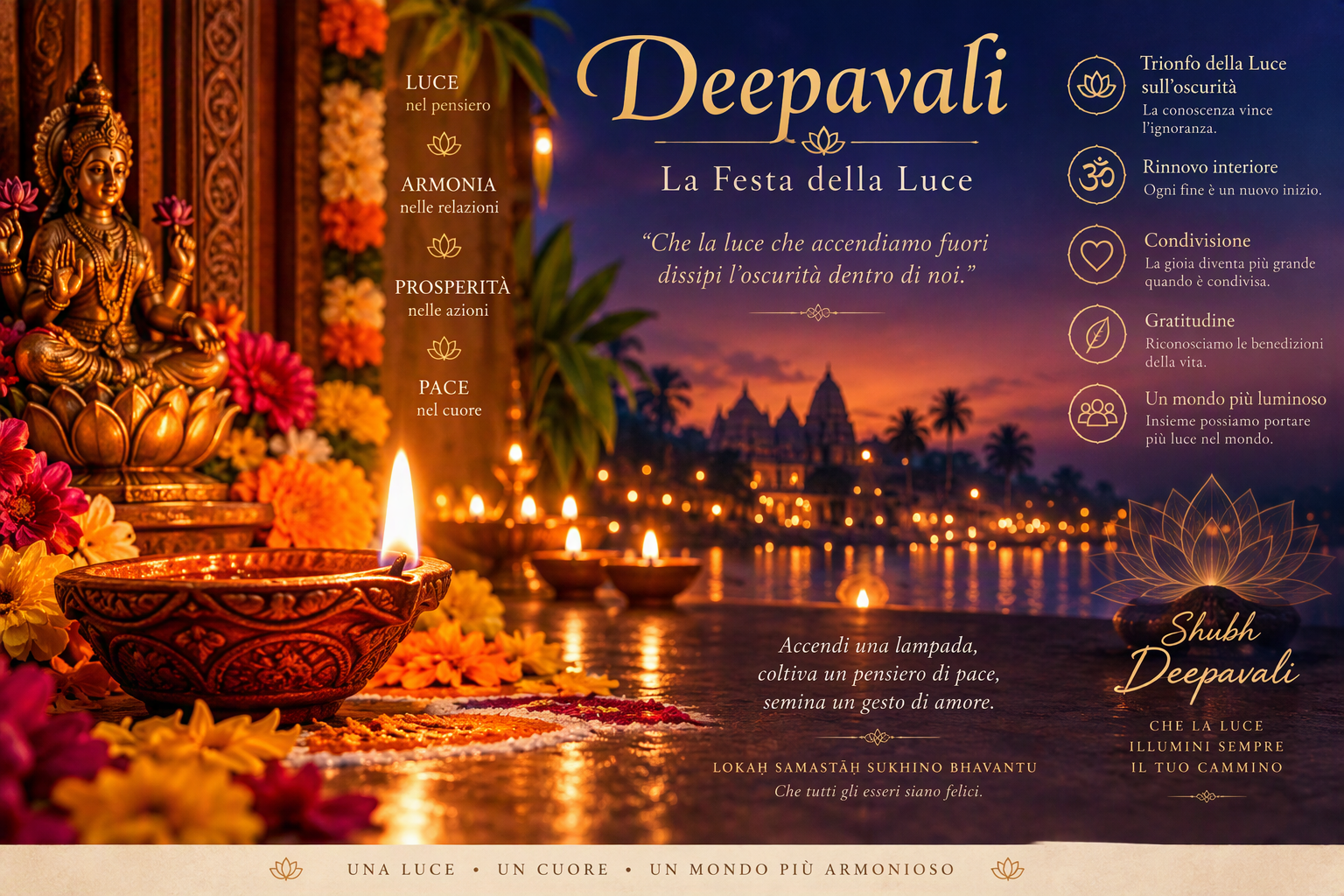
08 Nov Deepāvalī: la luce che non si spegne
Oggi, domenica 8 novembre 2026, è il giorno principale di Deepāvalī. La festa dura cinque giorni, da venerdì 6 a martedì 10 novembre, e il giorno centrale, la Lakshmi Puja, cade sempre nella luna nuova del mese di Kārtik. Il nome stesso racconta il gesto: dīpa (lampada) e āvali (fila), cioè “una fila di lampade”. Ed è già un paradosso: la festa della luce si celebra nella notte più buia del mese, quando la luna non si vede. Secondo il calendario di Nuova Delhi, l’Amāvasyā comincia l’8 novembre alle 11:27 e termina il 9 alle 12:31. È la stessa Luna Nuova di cui abbiamo parlato più volte: il momento dell’introspezione, in cui la luce si accende proprio perché fuori c’è buio.
Il significato spirituale profondo
Dalla lampada alla luce interiore. Il mantra che recitiamo nella Chakshushopanishad, asato mā sad gamaya, tamaso mā jyotir gamaya (Bṛhadāraṇyaka Upaniṣad 1.3.28), è la preghiera stessa di Deepāvalī: dall’irreale al reale, dal buio alla luce. La lampada esterna è un promemoria della luce che dobbiamo accendere dentro.
Il simbolismo della lampada. In una lettura molto diffusa tra gli insegnanti di Vedanta, l’olio rappresenta le tendenze accumulate (vāsanā), lo stoppino l’ego e la fiamma la conoscenza. Lo stoppino illumina consumandosi: l’ego trova il suo scopo quando si lascia bruciare nella conoscenza. È una lettura simbolica, non un dato dei testi, ma è bella e coerente.
La luce delle luci. Le Upaniṣad e la Gita (Muṇḍaka 2.2.10, Kaṭha 2.2.15, Gita 13.17) dicono che sole, luna e fuoco non illuminano il Sé: è il Sé a rendere visibile tutto il resto. Per questo si dice jyotiṣām jyotiḥ, “luce delle luci”. Le mille lampade di Deepāvalī indicano allora la Luce per cui vediamo le lampade: la coscienza che è testimone di ogni esperienza. È lo stesso filo che ci ha portato all’Āditya Maṇḍala e al Sūrya Maṇḍala Stotram.
La vera ricchezza. Lakṣmī è la dea della prosperità, ma la Gita (cap. 16) parla di una ricchezza divina (daivī sampat): coraggio, purezza, compassione, verità, serenità. Pulire la casa prima del suo arrivo è anche pulire la mente: la prosperità interiore non abita dove c’è disordine e inerzia (tamas).
Il ritorno di Rāma, il ritorno del Sé. Una lettura classica vede in Ayodhyā (“la non combattibile”) il cuore, e nell’esilio il tempo dell’oblio di sé. Il ritorno di Rāma è il ritorno della consapevolezza al suo posto naturale, e le lampade sono la gioia di quel riconoscimento.
La luce che si condivide. Una lampada può accenderne mille senza perdere nulla. È l’immagine del Pūrṇam Mantra: dal pieno nasce il pieno, e se si toglie il pieno resta il pieno. È anche l’immagine del satsaṅga: la conoscenza trasmessa non diminuisce chi la dona.
Come viverla
Per chi la celebra, anche in modo semplice: pulire e ordinare lo spazio, accendere una lampada con olio o ghee, restare qualche minuto in silenzio, ripetere un mantra o cantare insieme. In alcune tradizioni, specie bengalesi, in questa notte si accendono lampade anche per ricordare gli antenati: un collegamento naturale con il Pitṛ Paksha di cui abbiamo parlato.
E la luce continua ancora: quindici giorni dopo, nella luna piena di Kārtik, cade Dev Deepāvalī, “la Diwali degli dèi”, celebrata con migliaia di lampade sui ghat di Varanasi; nel 2026 è il 24 novembre.
Deepāvalī: The Light That Never Goes Out
Today, Sunday 8 November 2026, is the main day of Deepāvalī. The festival lasts five days, from Friday 6 to Tuesday 10 November, and the central day, Lakshmi Puja, always falls on the new moon of the month of Kārtik. The name itself describes the gesture: dīpa (lamp) and āvali (row), that is, “a row of lamps”. And it is already a paradox: the festival of light is celebrated on the darkest night of the month, when the moon cannot be seen. According to the New Delhi calendar, Amāvasyā begins on 8 November at 11:27 am and ends on 9 November at 12:31 pm. It is the same new moon we have spoken about many times: the moment of introspection, when light is kindled precisely because it is dark outside.
The deeper spiritual meaning
From the lamp to the inner light. The mantra we recite in the Chakshushopanishad, asato mā sad gamaya, tamaso mā jyotir gamaya (Bṛhadāraṇyaka Upaniṣad 1.3.28), is the very prayer of Deepāvalī: from the unreal to the real, from darkness to light. The outer lamp is a reminder of the light we must kindle within.
The symbolism of the lamp. In a reading widespread among Vedanta teachers, the oil represents accumulated tendencies (vāsanā), the wick the ego, and the flame knowledge. The wick gives light by consuming itself: the ego finds its purpose when it lets itself burn in knowledge. This is a symbolic reading, not something stated in the texts, but it is beautiful and coherent.
The light of lights. The Upaniṣads and the Gita (Muṇḍaka 2.2.10, Kaṭha 2.2.15, Gita 13.17) say that sun, moon and fire do not illumine the Self: it is the Self that makes everything else visible. This is why it is called jyotiṣām jyotiḥ, “the light of lights”. The thousand lamps of Deepāvalī then point to the Light by which we see the lamps: the consciousness that witnesses every experience. It is the same thread that led us to the Āditya Maṇḍala and the Sūrya Maṇḍala Stotram.
True wealth. Lakṣmī is the goddess of prosperity, but the Gita (chapter 16) speaks of divine wealth (daivī sampat): courage, purity, compassion, truthfulness, serenity. Cleaning the house before her arrival is also cleaning the mind: inner prosperity does not dwell where there is disorder and inertia (tamas).
Rāma’s return, the return of the Self. A classic reading sees Ayodhyā (“the unconquerable”) as the heart, and the exile as the time of self-forgetfulness. Rāma’s return is the return of awareness to its natural place, and the lamps are the joy of that recognition.
The light that is shared. One lamp can light a thousand without losing anything. This is the image of the Pūrṇam Mantra: from the full arises the full, and if the full is taken from the full, the full remains. It is also the image of satsaṅga: knowledge transmitted does not diminish the one who gives it.
How to live it
For those who celebrate, even in a simple way: clean and tidy your space, light a lamp with oil or ghee, remain a few minutes in silence, repeat a mantra or chant together. In some traditions, especially Bengali ones, lamps are also lit on this night to remember the ancestors: a natural link with the Pitṛ Paksha we spoke about.
And the light goes on: fifteen days later, on the full moon of Kārtik, comes Dev Deepāvalī, “the Diwali of the gods”, celebrated with thousands of lamps on the ghats of Varanasi; in 2026 it falls on 24 November.
No Comments